
If you’re starting your home buying journey, you’ve probably asked yourself this at some point.
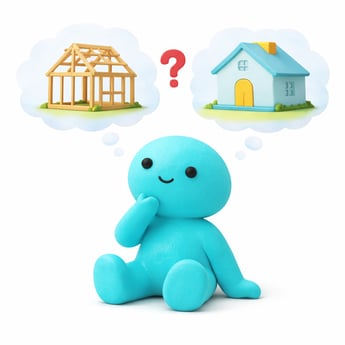
Should I build a home…
or buy something that’s already built?
It’s a fair question.
And the honest answer is — it depends.
But once you understand how each option works, the decision usually becomes a lot clearer.
Why this decision matters
For most first home buyers, this isn’t just about preference.
It’s about what actually gets you into the market.
Because while both options can work, they don’t always require the same deposit, upfront costs, or timeline.
And that’s usually where the real difference shows up.
Let's break it down...
Building a new home
- First Home Owner Grant available for new homes, generally $10,000–$30,000 depending on your state, which can help towards your deposit (with the help of a broker)
- Lower stamp duty, often calculated on the land cost rather than the full build price
- More control over design, inclusions and overall cost
- Less competition compared to established homes (no bidding wars or crowded inspections)
- Warranties, lower maintenance, and more modern, energy-efficient homes
Buying an established home
- Already built in established locations and ready to move in
- May be more affordable than brand new homes, depending on demand
- No construction timelines or delays during the transition from renting
- Potential to renovate or add value over time
- More flexibility to negotiate on price and terms
Where the real difference comes in
On the surface, both options can look appealing.
But for many first home buyers, the biggest difference comes down to what it actually takes to get started.
In a lot of cases, building can make it easier to enter the market sooner.
That’s because of things like:
- lower deposit pathways
- access to government incentives
- and additional support that may be available
Whereas buying established can sometimes require a larger deposit and higher upfront costs.
That doesn’t make one better than the other.
It just means one might be more accessible depending on your situation.
The takeaway
Building and buying both have their place.
But the better question isn’t:
“Which one is better?”
It’s:
“Which one gets me into the market sooner — based on my situation?”
That’s where the clarity usually comes from.
Pre-qualify and see if you can own
